
Knowing When to Turn Your Hearing Aids Down | Healthy Aging Series: Season 13, Chapter 5
It’s interesting, the things you remember from college. I remember the faces and names of some of the professors. I also remember those pithy statements that some of those professors made. Maybe that’s why I remember their names.
Dr. Edward Goodrich was my Greek professor. I can still read a little Greek. A little. But he wanted to share more than Greek; he wanted to share his wisdom.
He did that with what I call slogans. The first of the two I remember was, “Everything you think is not for public consumption.” I’ve tried to practice that for these past 45 years. Imagine how nice the world would be if people followed that slogan.
Mind you, at times it’s also important to tell people what you think. Knowing what’s fit for public consumption takes something called people skills, or what others call wisdom.
The second slogan is, “You have to learn to turn your hearing aids down.” Keep in mind that he was talking to college-age students, and I think we all realized that he wasn’t talking about real hearing aids. I realize that he, in his wisdom, was saying that not everything out there in the marketplace of ideas, ideologies, and doctrines is for public consumption.
I think he was saying: Don’t buy everything you hear. Be skeptical. Be discerning. Fact-check. Think. Use common sense. Be reasonable and open-minded.
Turning the volume down gives me room to consider what deserves my attention.
Imagine what the world would look like if we practiced that. I think the trick is knowing when to turn your hearing aids down. So I’ve given some thought to four areas where I’ve had to get on my Widex hearing aids app and swipe the volume button to the left.
Let me paint a picture of the current marketplace of ideas. It is messy: paint thrown up against the wall, colors outside the lines, sometimes gaudy in places. There are so many competing ideas, exploitative offers, and fear-based ploys on the Internet and social media, in media outlets, and in many profit and nonprofit organizations that it’s easy to feel dazed and confused.
Pick your poison: Politics. Religion. Money. Health. Fitness. Race. Sex. Aging. I’ve picked a few areas within these topics where I suggest that you turn down your hearing aids, stop and push pause, and make room for thoughtful listening.
1. Turn down your hearing aids when someone makes healthy living sound impossibly complicated.
When I was in my late 50s, I started being concerned about what my life was going to be like in my 80s. I asked myself, what is the best way to exercise: cardio or resistance? What is the best nutritional plan for an aging person? Should I take supplements? What about sleep? Why do I keep waking up at 3:00 a.m.?
I had lots of questions, and the information that I was getting off the Internet was about as confusing as it could get. So I did the only thing I knew to do and became a certified personal trainer through ACE.
I followed that up by becoming a strength and conditioning coach, a health coach, and a specialist in senior fitness and weight management. What did I learn?
The foundations of health and fitness are simpler than the marketplace makes them sound.
Move regularly. Walk. Build strength. Work on balance. Challenge yourself in ways that fit your abilities and give yourself time to recover.
Nutrition is simple, too. Michael Pollan wrote in his book In Defense of Food, “Eat food. Not too much. Mostly plants.” That’s it. If I were to name one thing we should do more of, it’s eat more fruits and vegetables. Amen.
2. Turn down your hearing aids when someone tells you your age has already determined who you are. It’s called ageism.
In a national survey, more than 9 out of 10 adults ages 50–80 reported regularly encountering negative messages or assumptions about aging—from other people, the media, or their own beliefs about getting older.
People who reported more of these experiences also tended to report worse physical and mental health. The study found a connection, but it couldn’t show that ageism caused the health problems. [1]
If you’re over 60, give or take a few years, some people think you’re spent and you’ve lost your value to society. You hear it all the time. It’s everywhere.
You can be a senior adult and still have new ideas. You can retire from a job but not retire from life. You can remain curious, adventurous, and open to new ideas in your seventies and beyond.
Here is the real problem: we begin to believe what we hear. We begin to believe that we have lost our value. We hear that still, small voice in our heads that says, “Let the younger people do it.” Or, “I’m getting too old for that.”
Or, “I have nothing to contribute to _______” (fill in the blank).
There are lots and lots of things you can do as an aging adult: teach, mentor, volunteer, create, start a YouTube channel, be politically active. Lots of things! When you hear others and yourself saying, “I’m too old for that,” turn your hearing aid down.
3. Turn your hearing aid down when someone’s cynicism becomes your cynicism.
Stop listening to all the negativity. There’s nothing wrong with a little skepticism and cynicism, but there are people and networks that thrive on cynicism, and if you listen to them enough, you’ll get swallowed up in their cynicism.
My wife and I stopped watching local news in the mornings because it was affecting the way we thought about our community and about people. We started turning down our hearing aids, and it has helped.
My siblings and I used to joke about our mother having a bubble around herself, and we called it Betty’s Bubble. It was her way of turning down her hearing aids by limiting the information and people that she allowed into her psyche.
There’s nothing wrong with questioning what you hear. But when every conversation becomes a complaint and every motive is suspect, it’s worth noticing what that outlook is doing to you.
4. Turn your hearing aids down when you encounter Mr. Chambers’ Troublesome Trio.
I want to share a lesson from my high school psychology teacher, Mr. Chambers, and something that he called Chambers’ Troublesome Trio. Here is what he explained about the Troublesome Trio: “Never talk about politics, money, or religion in mixed company.” That was in 1974, and it was about proper etiquette.
Maybe a more modern rendition would be: You don’t have to post every opinion you have about politics, religion, and money on social media. This falls under Professor Goodrich’s first admonition: not everything you think is for public consumption.
But I think it’s equally true that when one or all of these show up at a dinner table, you can turn your hearing aids down and pass the potatoes. Be quiet. Observe. Listen to people. Ponder what is being said, and then pass the potatoes.
You can even say, “Tell me more,” “Interesting,” or even “Curious,” and then pass the potatoes.
If you want to take care of yourself during these divisive times—but really, during any era—learn when to turn your hearing aids down.
Everybody’s getting older these days. There is no manual. I look around and see some people aging well and some not, and I wonder if maybe those who are aging well are aging well because they’ve learned how to turn their hearing aids down.
Learn to turn yours down. It has helped me feel better and become less irritable. And maybe, just maybe, it will help you enjoy the process of getting older.
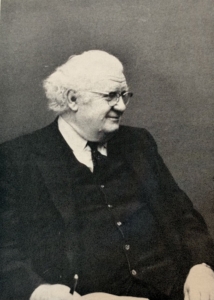
Professor Goodrick

A scene from the college campus in Portland, Oregon
Study Source
[1] Allen JO, Solway E, Kirch M, et al. Experiences of Everyday Ageism and the Health of Older US Adults. JAMA Network Open. 2022;5(6):e2217240. Published June 15, 2022. doi:10.1001/jamanetworkopen.2022.17240.