Simplicity is Not the Key to Happiness | Healthy Aging Series: S12 E10
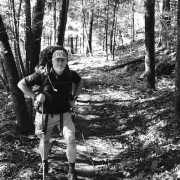
There are 5 common mistakes that rookie-backpackers make in their early years.
First, they lack physical conditioning. I have a backpack with 40 lbs. of cat-litter in the back of my Jeep. I strap it on and I do hill repeats once a week.
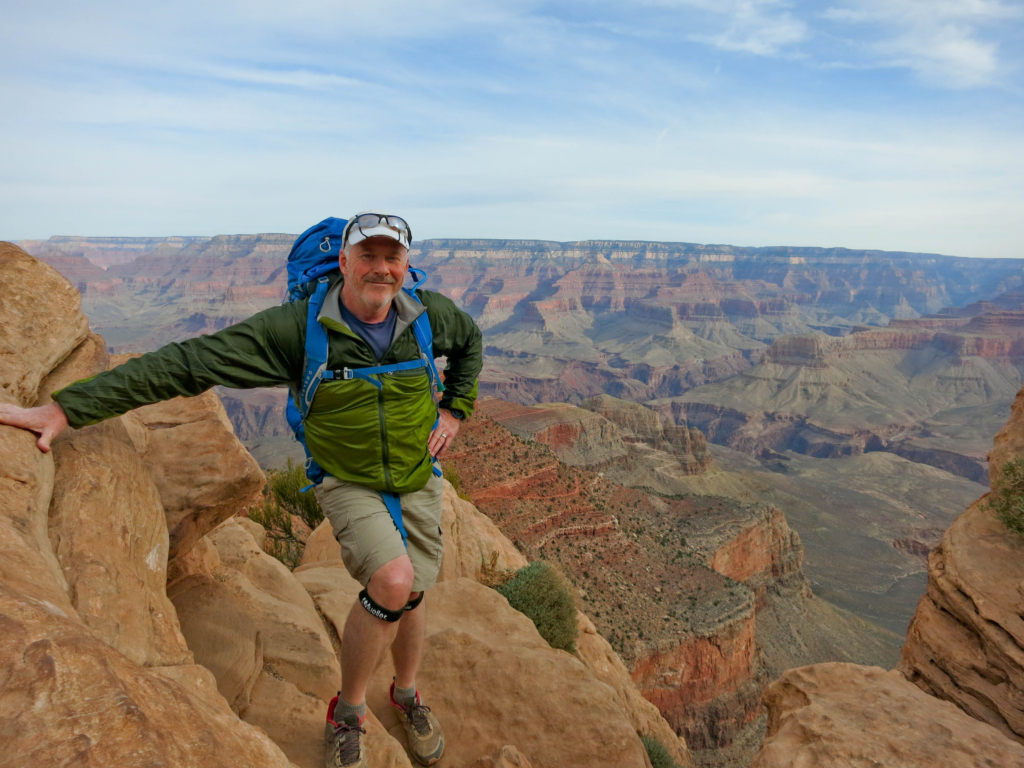
Second, they forget an important piece of equipment. My first backpacking trip was in the Grand Canyon. We forgot our tent. I know.
Third, they fail to test their gear before a long trip. On one of my trips to the Grand Canyon, I noticed a couple having a difficult time setting up their tent. They had never set it up before backpacking into the Grand Canyon.
Fourth, they bring an axe. Never bring an ax! Or, forgetting a lighter or matches. My son and I were camping at 11-mile Lake in Colorado, and we forgot to bring matches/a lighter. We had to hike out and get them.
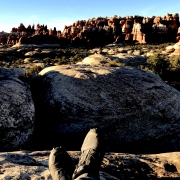
Fifth, carrying too much weight in your pack. Sometimes it’s necessary. When I did a backpacking trip in Canyonlands National Park, I had to carry 12 liters of water for four days which ended up being 26 lbs. My pack weighed 70 lbs. That took the fun out of it for the first few days.
It’s usually #1 and #5, when taken together, that make a trip one of those, “Eff this, I’m done,” trips.
An example of this was on my third or fourth trip to the Grand Canyon. We invited our son to do the Canyon for his Senior Trip. He had never backpacked, so I made sure his pack weighed less than 25 lbs. There was a tradition with our group, of weighing our packs just prior to dropping down into the South Rim on the Bright Angel Trail. My pack weight: 42 lbs.
We noticed that there was a new couple, Frank and Gwen, who were in their mid 50s. Gwen had quit smoking the previous year and had started hiking in the White Mountains to prepare but had never put on a backpack. Her pack weight: 45 lbs. My son and I gave each other the “she’s-not-gonna-make-it” look.
People who think going downhill is easier would be wrong. The first leg of our trip was down the Bright Angel Trail to the Havasu Garden campsite about 5 miles, dropping about 3,000 feet of elevation. It took my son and me three hours to get to the campground, arriving just before dark. About two hours later Frank and Gwen arrived, Gwen without her pack. “My legs were rubbery,” she explained. She had dropped her pack halfway down. I’m guessing they shared a sleeping bag that night. The next morning, they hiked out and recruited a young man to go down and carry out her pack. Lack of conditioning? Probably. Too much weight? For sure.
That was 20 years ago. Over the past decades, the backpacking community has focused on ultralight backpacks and gear. The focus now is how low can you get the base weight of your pack. The “base weight” means everything but food and water. The goal is less than 20 lbs. Less weight means more fun!
Traveling Light
I recently picked up a book via kindle. It was free. Thank you, Kindle Unlimited. The title was, “Journeys of Simplicity,” by Philip Harnden. It’s a book of lists of things that people possessed when they pass away or were on a lengthy journey. There are about 20 noteworthy people, and by that I mean, people who practiced austerity and spirituality. The book implied that these people were virtuous because of their austerity.
An example would be Edward Abbey’s list of the things that he had while floating down through the Glen Canyon.
Two rubber boats
Paddles
Food supply, mostly beans and bacon for two weeks
Texaco road map of the state of Utah
Bedroll camping gear, wrapped in a tarpaulin
Rusty harmonica
Pipe and tobacco
My mother’s list when she passed:
5 or 10 outfits in her closet
32-inch TV
One recliner and love seat
One bed
One bulletin board with pictures of her children and grandchildren
Dishes
Tupperware with Lorna Doones in it
One Kitty
200 books
Throughout the centuries, there has been a Simplicity Movement, kind of a spiritual KISS, Keep it Simple Stupid Movement. I use “spiritual” not in a theistic sense, but in the self-discovery sense, in the “Becoming your Authentic-Self” sense.
Richard Foster, a Quaker Theologian, wrote in his book “The Freedom of Simplicity,”
“Simplicity involves a consciously chosen course of action involving both group and individual life. What we do does not give us simplicity, but it does put us in the place where we can receive it. It sets our lives before God in such a way that he can work into us the grace of simplicity. It is a vital preparation, a cultivating of the soil, a ‘sowing to the Spirit,’ as Paul put it.”
In other words, to Foster and Harnden, Simplicity is a spiritual discipline, even a sacrament, and is synonymous with virtuosity. Austerity equals piety, which equals virtue. Austerity removes the things from our lives that prevent us from experiencing happiness and joy. The Simplicity Movement asserts that happiness is result of how we spend our money, or how little we spend our money on things. The danger is that this “Race to Austerity” can produce a false piety. Only those who divest themselves of all worldly possessions are truly pious.
I would assert that it isn’t how we spend our money that brings about a meaningful life, but rather, it’s what we spend our life doing.
This isn’t to say that people who practice austerity cannot also spend their lives doing good or practicing altruism, but austerity is not sufficient for goodness or virtue. And likewise, people who do not practice austerity, but practice altruism, by using their time, money, and talents, can truly have rich lives.
I am not pooh-pooing simplicity.
I’m not discouraging you from simplifying your life. Give away the things you don’t use. Clean up your calendar from things that steal your solitude. Turn off the TV. Eat out less often. Cull people from your true-friends list. Declutter your home. Learn to say no. Stop buying things you don’t need.
Although the process of simplifying might help you with your focus and overall well-being, there is almost nothing virtuous about it.
Your ability to be a change agent in this world is not dependent on selling off all your possessions. It depends on a virtuous life, a life doing virtuous things. A life of altruism.
Life isn’t a competition to see who can own the least number of things, but it also isn’t a license to hoard your money, accumulate great wealth, or any wealth for that matter, and not spend it and your life doing good in the world.
If you want to seek virtue then be virtuous, and you do that by investing your money and your life in the lives of others. That is the key to happiness!
Here was Bilbo Baggins list as he set off one fine morning:
A borrowed dark-green hood, a little weather stained.
A borrowed dark-green cloak, too large.
A lot of pocket handkerchiefs.
Pipe and tobacco.
Forgotten: hat, walking stick, and money.