Help Me Obi-Wan Ken Obi, You’re My Only Hope | Healthy Aging Series: S12 E20
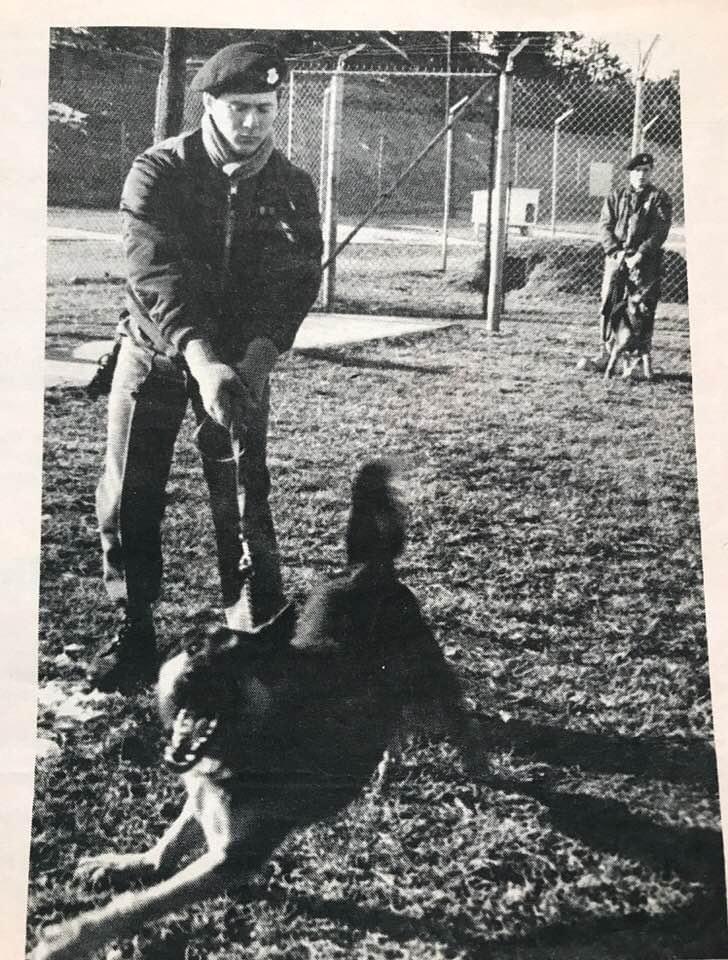
In the 1970s, if you were in the military and stationed in Korea, it was called a Remote Tour. That meant you were separated from your family for up to 13 months. Of course, in the 70s the only thing that existed was the Postal Service. There was no Internet. There was no e-mail. No Cell Phones, just letters.
There was MARS (Military Affiliated Radio System) that I used to talk with my family. You were able to actually talk, but there was at least one other person listening in (a Ham Radio Operator) on the conversation and you had to say “over,” when you finished your side of the conversation. I did it once.
So, mail was really important. My sister Marsha would send me a care package every couple of months, that included homemade cookies. She used old Pringle canisters to ensure the cookies were whole when they got to me. I wrote letters almost every day to my parents, family, and friends.
You were remote. There was AFN (Armed Forces Network). You could watch football games, and it seems like there were a lot of METV programs, but I guess that was current TV back then.
I didn’t have a TV and really didn’t see many TVs. I was in Korea for two years, mostly without television. I missed a lot of what was going on in the states. So, to some degree remote meant isolated. The only cultural things that you got were from Airmen rotating in from the states.
In June or July of 1977, I started hearing names of Luke Skywalker, Princess Leia, Han Solo, Chewbacca, Obi Wan Kenobi, and of course Darth Vader. I didn’t have a clue what people talking about. They were saying things like, “May the force be with you,” and “Do or do not. There is no try.” And “Help me Obi Wan Kenobi, you’re my only hope.”
People wouldn’t shut up. A year later, I was discharged from the United States Air Force, moved to Portland, OR for college and waited for the re-release of “Episode IV: The New Hope,” and eventually for the opening of the “Empire Strikes Back” in 1980.
Yeah, I finally got it. The ultimate battle between good and evil, and the loss of hope for the Rebellion against the Galactic Empire. I remember standing in line for both movies. That was 46 years ago. It made that deep of an impression on me. “Help me Obi-Wan Kenobi, you’re my only hope.”
Those words still resonate with many people today, people who are feeling hopeless. There’s a kind of corporate grief that I’m seeing today, and it cuts across all ages, even the Red/Blue division in our country. We all wish there was an Obi-Wan to help us, to end the despair, and give us hope.
I watched “Episode IV: The New Hope” while writing this blog to see what exactly Obi-Wan did to turn the tide against the Empire and bring hope. Honestly, not much. He talked a lot. Maybe, inspired is a better way to say it. He helped Luke to use the ways of the force. Obi-Wan wasn’t a Jedi in the sense of being a Jedi knight in this movie, not a soldier, but a Messenger, or a Shaman, or a Sage. We see him in Chapters 5-11 in the movie. He’s killed by Darth Vader in Chapter 11, and the bulk of his appearances throughout the rest of the trilogy are voiceovers. Throughout that time, he inspired people with his words. He helped develop a vision for the future and inspired courage to bring about that vision.
I’m often reminded of that verse in Hebrew Scriptures, “Where there is no vision, the people perish” (Proverbs 29: 18). Maybe I’m taking a little license with this verse, you know, taking it out of context, but it seems to me that a Prophet of Hope needs to create a vision of a world without evil, without tyrants, and one that promotes social justice, respect, and compassion for
those less fortunate.
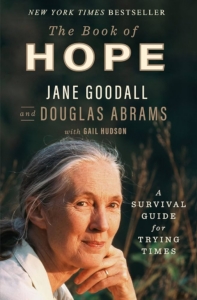
There have been many, many, Prophets of Hope throughout the ages. More recently, I picked up Jane Goodall’s book, “The Book of Hope.” I bought the paper copy and the Audible copy. The Audible version had Jane Goodall reading her lines. This book is mostly an interview that co-author Douglas Abrams had with Goodall. He’s also the co-author of the book, “The Book of Joy,” with the Dalai Lama.
What Is Hope?
“Hope” Goodall explains, “is what enables us to keep going in the face of adversity. It is what we desire to happen, but we must be prepared to do hard work to make it so.”
“We can know the direction we want to go, and we can hope that it is the right direction. You won’t be active unless you hope that your action is going to do some good. So, you need hope to get where you’re going, but then by acting, you generate more hope. It’s a circular thing.”
Jane Goodall was a Prophet of Hope.
Here are the things that inspired her to be hopeful, the reasons for her hope.
1. The Amazing Human Intellect.
Jane believed that the human race has the capacity to think itself out of its despair and turmoil. There is nothing wrong with passion, but passion alone is not going to fix our country. Heather Cox Richardson, another Prophet of Hope, writes a daily newsletter. In her April 13, 2026, letter, she shares part of a speech from Franklin Delano Roosevelt in 1932, at the Democratic National Convention. “Out of every tribulation, every disaster, humankind rises with some share of great knowledge, or higher decency, or pure purpose. Today we have come through a period of loose thinking, descending morals, and an era of selfishness.”
A period of loose thinking! Goodall believed, and I think she is reflecting what FDR believed, that many of our problems are the result of loose thinking. Critical thinking is what Jane Goodall believed would get us through these times of turmoil.
2. The ability to share our grief with each other.
We have to grieve. Ignoring our pain is not the answer. Our ability to share our grief with each other can be inspirational. Corporate grief is what fuels revolutions.
3. The Power of Young People.
Let me be very clear, young people did not cause our problems. Young people did not cause the housing crisis, the high cost of an education, the poor job market, the war in Iran, or the hopelessness that pervades our country, just to name a few of our problems.
But they have power! Maybe not fully realized yet, but they’re smart, they are hardworking, and they have a vision for a better planet. Maybe it’s time for Boomers to move aside. It’s time to encourage young people to step up.
4. The Indomitable Human Spirit.
Maybe, Goodall was naive about the human race. She believed that there is something within us, a spark, a flame that is inextinguishable. It’s something within us that wants the betterment of all. An Altruism gene.
I know it’s damaged in some, but not all of us. The indomitable human spirit wants goodness, seeks goodness, and hopes for goodness. That’s what gave Goodall hope. She was a Prophet of Hope, and she used words. That’s how we become Prophets of Hope. We tell our family, friends, and anyone that will listen, that there is a better way, a kinder way.
Maybe young people are our only hope.
I’m a Boomer, and I’m not stepping aside.
Come and stand next to me, and we’ll build a more hopeful place to live.